

- > Diablo 4 Season 14 Mythic Unique Crafting Guide After the Latest Hotfix: Get Your Dream Mythics Efficiently
- > Diablo 4 Etna’s Lost Dagger Guide: Drop Locations, Stats, & Best Rogue Builds
- > Diablo 4 Corrupted Reaper Boss Guide (Season 14) – Location, Mechanics & Loot Table
- > Diablo 4 Exalted Boss Guide: How to Beat Belial, Lord of Lies
- > Diablo 4 Season 13 Summoning Guide: Lair Keys vs. Greater Lair Keys
- > Diablo IV Mastermind Warlock Build: Lord of Hatred | Season 13
Diablo 4 Life on Kill Affix Type Explained: Is It Ruining Your Endgame Gear?
When you are deep into optimizing an endgame build, every single stat line on your legendary gear matters. A single wrong roll can be the difference between easily clearing a high-tier Pit or constantly staring at a loading screen. One stat that regularly causes confusion for players manipulating their gear is Life on Kill.
Understanding exactly what affix type Life on Kill belongs to—and how it behaves under Diablo 4's Horadric Cube crafting mechanics—is essential for saving your hard-earned gold.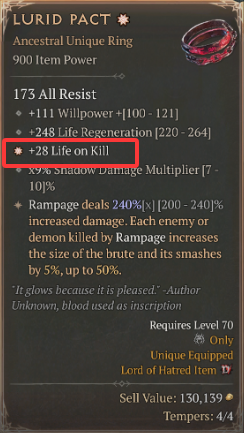
What Affix Type is Life on Kill in Diablo 4?
In Diablo 4, Life on Kill is classified as a Defensive affix.
When manipulating your gear using Horadric Cube transmutations, adding, removing, or rerolling this stat is governed strictly by the Protector's Tuning Prism category. If you are performing a Focused Reroll on an item to swap out an unwanted utility or offensive stat, you cannot accidentally roll into Life on Kill unless you are explicitly targeting the defensive branch using a Protector's prism.
Affix Classification
- Affix Classification: Defensive
- Crafting Group: Protector’s Tuning Prism
- Eligible Classes: All classes (Barbarian, Druid, Necromancer, Sorcerer, Spiritborn)
- Inherent Weapon Rolls: Found as a built-in baseline passive on 1h Scythes and 2h Scythes for the Necromancer class.
Life on Hit vs. Life on Kill: The Endgame Reality Check
Many players mistake Life on Kill for its much stronger cousin, Life on Hit. While both are defensive affixes found in the Protector's Tuning Prism Group, they function completely differently in practice:
- Life on Kill: Heals you for a flat amount only after an enemy dies.
- Life on Hit: Heals you every single time your skills connect with an enemy.
Why Life on Kill Fails in the Endgame
While Life on Kill feels great while clearing large packs of weak monsters during Helltides, it becomes a completely useless stat line during endgame boss encounters. When you are fighting standalone bosses like Uber Lilith, Tormented Duriel, or high-level Pit Guardians, there are no minions to kill.
Because you cannot trigger the healing effect against a solo target, carrying Life on Kill instead of Max Life, Damage Reduction, or Life on Hit means you are essentially fighting at a severe disadvantage.
The Massive Gold Sink: The True Cost of Rerolling Affixes
If you drop a piece of Ancestral gear with incredible Greater Affixes (GA) but it unfortunately rolled with Life on Kill, you face a major problem. Replacing or rerolling an affix using Horadric Cube Crafting Caches or visiting the Occultist for traditional enchanting can destroy your in-game wallet.
[Your Gear] ➔ Contains Unwanted "Life on Kill" Affix
      │
      ▼
[RNG Reroll Attempt] ➔ Costs Million+ Gold per click
      │
      ├─► Success: Got Max Life or Damage Reduction!
      │
      └─► Failure: Got Fire Resistance (Gold cost scales up drastically)
Because of random number generation (RNG), you can easily burn through 50 million to over 100 million gold just trying to roll away a single bad defensive stat. Farming that much gold manually requires endless hours of repetitive material grinding, turning a fun ARPG into a tedious second job.
Table of contents
Recommended Article